Finding Meaning in Mortality: A Radical Exploration of Conscious Living and Dying


Featuring: Bruno Rizzi
What grounds us when our usual securities fall away? When health shifts, when loss arrives, or when we face the unavoidable fact of our own mortality, what is left to rely on?
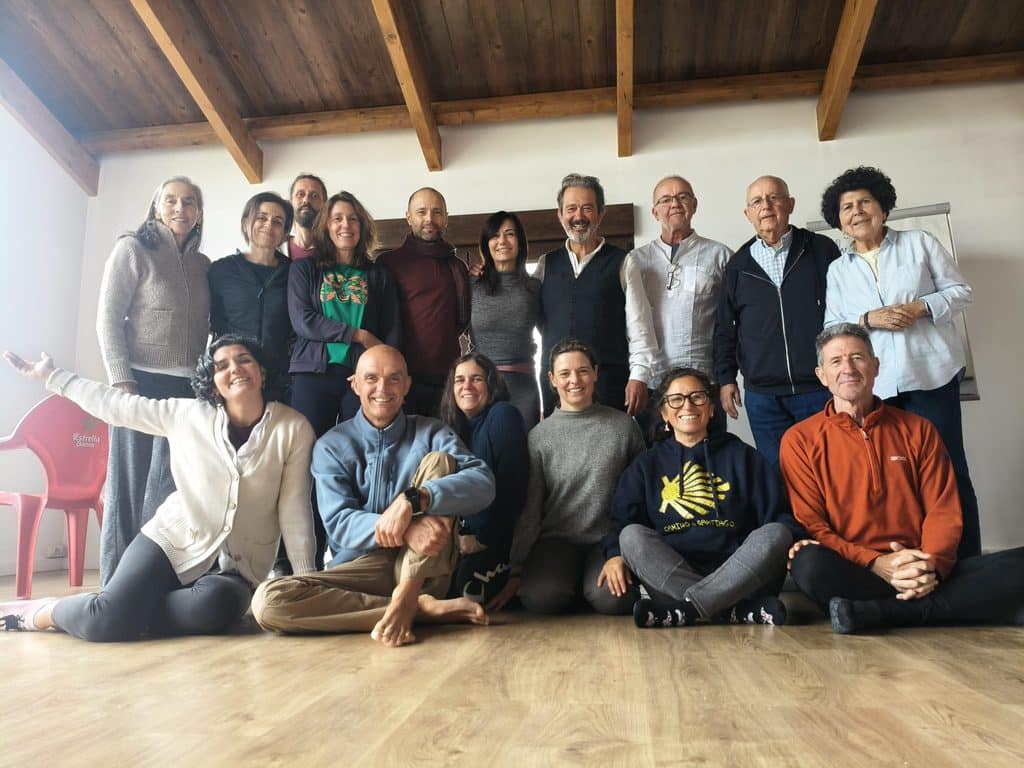
These questions formed the foundation of a three-day residential retreat held in the Spring at Centro Nagarjuna in Alicante, Spain, entitled: “The Invisible Thread That Supports Us: A Radical Exploration of Conscious Living and Dying.”
Led by Bruno Rizzi, an accredited 16 Guidelines facilitator with more than two decades of bedside palliative care experience, the retreat marked the second consecutive year participants gathered in the Spanish countryside to explore how looking directly at death transforms the way we inhabit life.
The Vision: Moving Beyond the False Divide
Modern culture often treats life and death as opposing forces: one to be extended at all costs, the other to be hidden from view. Yet in palliative care, as in ancient contemplative traditions, experience shows the opposite: life and death deeply permeate one another. What nourishes one inevitably supports the other.
Rooted in the philosophy of Universal Education, first articulated by Lama Thubten Yeshe and championed by the Foundation for Developing Compassion and Wisdom (FDCW), the retreat approached this subject by deliberately bridging science, psychology, and contemplative insight.
In his post-retreat reflections, Bruno articulated the philosophical necessity behind this format:
“In presenting his vision of Universal Education’s approach, Lama Thubten Yeshe strongly encouraged us to overcome the widespread modern tendency either to reject the spiritual human dimension present in human beings or to fail to recognise the value of pragmatic, non-dogmatic scientific investigation. Especially nowadays, it is widely recognised how necessary it is to integrate these two aspects if humanity does not wish to fall into very dangerous extremes.”
Bruno notes that human beings are not merely physical, emotional, and psychological organisms living in isolation. We exist within a broader, often mysterious context. When we encounter crisis or the end of life, purely intellectual or material answers fail to comfort us. What we require is access to an inner, spiritual dimension, one free of sectarian labels, dogma, or religious exclusivity.
Integrating Science, Contemplation, and Hospice Realities
The retreat wove together three distinct streams:
- Contemplative investigation: Gently exploring the nature of consciousness through meditation and inquiry.
- Scientific frameworks: Understanding psychological defence mechanisms, cognitive processing, and physiological stages of transition.
- Bedside clinical practice: Practical, unvarnished insights drawn from Bruno’s 22 years as a palliative nurse at Christophorus Hospiz in Munich, Germany.
Through this lens, the discussion moved away from abstract philosophy into lived human reality: What happens to a person during the physical and emotional process of dying? What do people genuinely need in their final days and hours? And how do our daily mental habits dictate our capacity to meet those moments with composure?
As Bruno reflected on the group’s discoveries:
“During the three days merged in a wonderful Spanish landscape, the group focused on deepening our understanding of the spiritual dimension. Fundamental was a gentle exploration of the nature of consciousness, comparing insights from contemplative traditions with scientific understanding, and sharing real hospice experiences of how people meet death.
It was not too difficult then to perceive how and why an embodied ethical way of life, based on authenticity and responsibility, gives perspective and deeper meaning to our living. The key to the satisfaction and peace that we long for lies in developing our limitless capacity to know and understand, alongside our capacity for wisdom and loving-kindness. Deciding to enter into this challenging journey reverberates in giving ease, peace, and acceptance when approaching the end of life. This is experience.”
The Methodology: A Safe Container for Deep Inquiry
Confronting impermanence can easily become overwhelming without careful guidance. The structure of the retreat was designed specifically to keep participants grounded, emotionally regulated, and engaged.
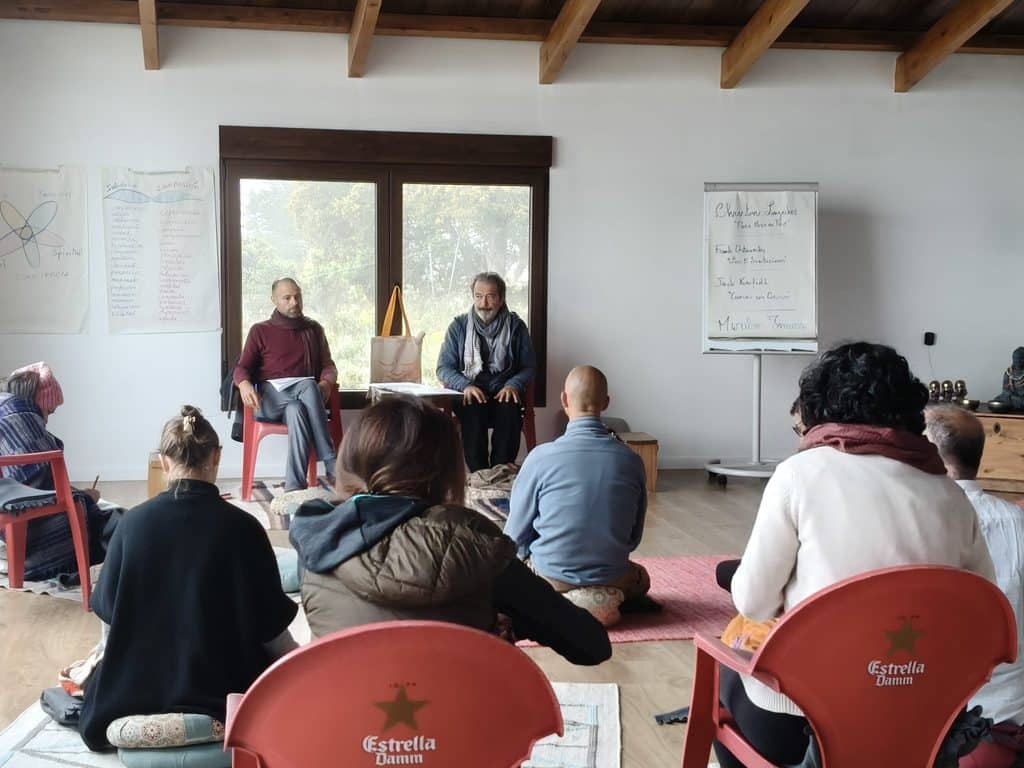
Participants maintained silence during breaks and outside formal sessions, and disconnected entirely from mobile devices and social media. This intentional quiet created space for difficult insights and emerging emotions to settle and integrate rather than being quickly numbed or intellectualised.
Within the sessions, the dynamic shifted between:
- Solitary reflection and meditation, allowing personal grief, anxieties, and questions to surface safely.
- Paired and small-group dialogues (groups of two or three), giving participants structured opportunities to articulate vulnerable reflections and listen deeply to peers.
- Large-group debriefs, where practical clinical knowledge and universal principles were discussed openly.
Jessica M. Pastor, Director of Centro Nagarjuna Alicante, observed how this multi-layered approach affected the room:
“For the second year in a row, we have been fortunate enough to host a retreat with Bruno Rizzi. With grace and in a very subtle, gentle way, he guided us along the path of the journey toward death: our own, that of our loved ones, and that of strangers. What was most surprising was that he did so from the perspective of life.
From his practical and experiential perspective, he gave us keys to live from the perspective of death. The presentation of the Buddhist aspects of death through the lens of Universal Education made this retreat completely accessible to everyone, whether Buddhist or not. We were delighted to see new faces as well as returning participants, showing remarkable cohesion and adaptability.”
From Fear to Familiarity: What Participants Experienced
For attendees, the experience altered how they relate both to their own mortality and to everyday challenges in their relationships and personal lives.
Meeting Personal Fears Directly
“I went to the retreat to confront myself and my fears regarding death—my own death and that of my loved ones—and I found myself. Bruno’s suggestion to spend the retreat in silence and without a mobile phone helped me do this, as did his guidance, his experience, and the dynamics in small groups.
The varied program helped my mind stay present, delve deeper into the topic, face it head-on, and become more familiar with it each day. Integrating these approaches is a process that obviously does not end with the retreat, but rather begins here.”
— R. M.
Bringing Meaning into Daily Actions
“One of the first things I noticed was the clarity with which the material was developed. The fact that it is based on Universal Education gives it a very practical relevance to our daily lives. It helps us understand how we can relate to whatever happens to us, even when thinking about the moment of death.
The information conveyed about the process of dying—and its connection to attitudes we should strengthen and cultivate—will help us at that final moment, but also throughout our lives. The practical activities and debates were of immense help for my personal inner work and in how I relate to the world.”
— A. M.
A Safe, Non-Dogmatic Spiritual Space
“Confronting death is no easy task, and doing so in a space where you feel safe and supported—without becoming emotionally overwhelmed—is even harder. Bruno achieves this from the first moment with calm, loving clarity.
The universal language clarifies the concepts and conveys the philosophy to all audiences. It helped me learn what people need at the end of life and reflect deeply on my own death. Exploring the spiritual dimension free from judgment or religion was revelatory. It is difficult to put into words because many of these insights are not merely intellectual; they leave a lasting imprint on the soul.”
— G. E.
The Revitalising Power of Facing Impermanence
Rather than leaving participants somber or dispirited, looking honestly at impermanence proved energising. When death is no longer treated as a taboo subject to avoid, the unnecessary tensions, petty resentments, and superficial distractions of life lose their grip.
What remains is an appreciation for what matters most: authenticity, responsibility, loving-kindness, and mutual care.
As Bruno noted in his closing thoughts, discovering how to face impermanence creatively is “highly revitalising.” Armed with renewed perspective and practical tools, both the participants and the organisers confirmed that this shared journey will continue, with a resolve to meet in retreat again next year.
Continue Exploring
- Practice: Experience Bruno’s approach in your own time with this Awareness of Death Meditation on YouTube.
- Preparing for Death, the Greater Resource is Love – Ven Carla Pearse
- Read Next: Confronting impermanence often brings our relationship with loss to the surface. Discover practical tools in our latest article: Understanding Grief: How to Cope with Grief and Loss.

Foundation for Developing Compassion and Wisdom (FDCW)
At FDCW, we are committed to a more compassionate, wiser world. We provide resources, courses and training to develop qualities such as kindness, patience and honesty – qualities that are essential for meeting the challenges of the world we all share.
The Foundation for Developing Compassion and Wisdom (FDCW) was established as a global charity based in London in 2005. Since then, we have provided secular training, programmes and resources across many sectors of society – schools, universities, hospices, workplaces, healthcare, youth groups and community centres. Our courses have reached thousands of people across the world through our dedicated and growing network of facilitators in more than 20 countries.
Support our Work
As a non-profit organisation, FDCW relies on donations like yours to continue producing valuable resources and hosting events. You can support us by sharing our newsletter, following us on social media, and making a donation. Every contribution, big or small, helps us in our efforts and we truly appreciate it.