

How a Hospice in Australia Rebuilt Its Values from the Inside Out


Karuna Hospice is a free, community-based palliative care service in Queensland, Australia, walking alongside people and families facing life-limiting illness. Much of its care takes place in the familiarity of home, where comfort, dignity and connection matter most. Karuna’s support reaches beyond physical care. It offers spiritual and emotional support to those navigating grief, uncertainty, carer fatigue and existential distress. People do not need to be receiving palliative care to access this support, families, partners, carers can all reach out. Self-referrals are welcomed, and care continues for as long as it is needed.
At its core, Karuna is about relationship, about being present at some of life’s most tender and vulnerable moments. And that led to an important question: what values truly guide the way we care? It was this reflection that inspired Karuna to revisit its hospice values and ultimately rebuild them from the inside out.
Rebuilding Hospice Values That Truly Matter
When Karuna Hospice set out to refresh its organisational culture and values, the intention wasn’t cosmetic. This wasn’t a rebrand. It was a genuine, whole-of-organisation inquiry: what truly matters in the way we care, connect and work together?
Like many organisations, Karuna had a set of values on paper, but they didn’t feel rooted in the daily experience of the staff. As one leader put it, “They didn’t resonate.” Staff members wanted a sense of shared language and purpose, something that reflected their roles, responsibilities, and relationships with one another and the families they serve.
Rather than choosing another generic values list, Karuna turned to the 16 Guidelines for Life a framework for cultivating care & compassion, wisdom, and ethical action. The result was a transformation that reshaped the hospice’s culture from the inside out, creating a set of values that now support every conversation, every review, every decision, and every act of care.
Why Karuna Reviewed Its Hospice Values
Working in end-of-life care invites reflection, not only about the lives of those being supported, but also about the systems and cultures behind that support. For Karuna, the need for change came from within: staff feedback suggested that the existing values were no longer fit for purpose. They felt disconnected from the day-to-day jobs and lacked emotional weight.
The team wanted values and guiding principles that would be lived rather than laminated, values that could hold up under pressure, reflect a spirit of care and integrity, and grow with the organisation through continuous improvement over time.
The 16 Guidelines, developed by the Foundation for Developing Compassion and Wisdom (FDCW), offered exactly that. With themes such as how we act and how we relate, they provided an accessible but profound structure. Their non-prescriptive language allowed space for personal interpretation and real-world application, an ideal match for Karuna’s diverse staff.
A Values Committee, made up of staff from different departments, was created to lead the process. Their task: to ensure that this wasn’t a top-down initiative, but a co-created journey rooted in inclusion and openness.
How the New Values Were Created and Embedded
The first step in Karuna’s values journey was reflection. Staff were invited to vote for one guideline from each of the 16G’s four themes: how we think, act, relate, and find meaning. This democratic approach ensured early buy-in and created a sense of ownership.
The chosen four guidelines then became the hospice’s core values. But instead of leaving it there, the team wanted to go further: how would these values actually show up in practice?
Each value was explored through three practical lenses or pillars:
- Organisation – How does this value shape policies, governance, and overall culture?
- Team – How does it guide internal relationships, communication and cooperation?
- Service – How does it influence the way support is offered to patients and families?
Every value was unpacked through staff-wide workshops – two-hour sessions held quarterly. These sessions were facilitated by in-house leaders, including Ven Tsultrim, and gave staff a chance to reflect on what each value meant to them professionally and personally.
This wasn’t a one-off training. It was embedded into onboarding, supervision, reviews, and meetings, with new staff rotating through the same workshops to ensure they weren’t left behind. The process was dynamic, allowing room for shared learning and ongoing growth.
The Four Values That Now Guide Karuna
After a period of reflection and staff voting, Karuna selected one guideline from each of the four 16G themes. Together, these now form the foundation of their hospice values shaping not just policy, but presence.
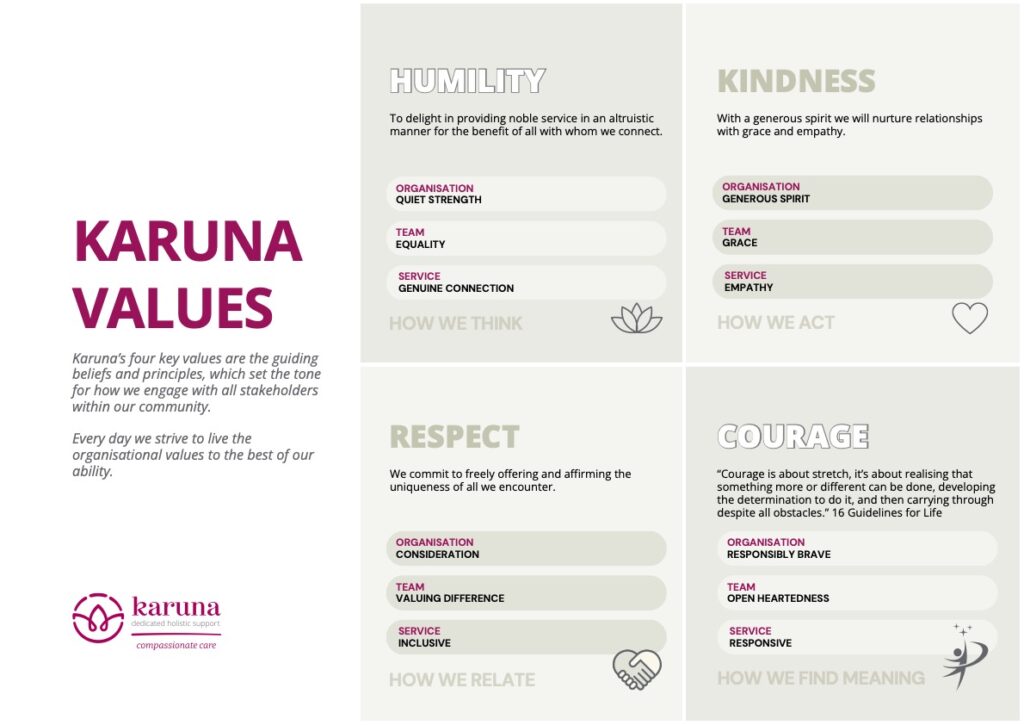
Humility – How We Think
To delight in providing noble service in an altruistic manner for the benefit of all with whom we connect.
At Karuna, humility is understood as quiet strength. It is the recognition that hospice work is not about recognition or status, but about service. Humility invites staff to approach each encounter with openness, ready to listen, to learn, and to recognise the dignity of the person in front of them.
In the workshops, staff reflected on how humility shifts perspective from “my role” to “our shared purpose”. It encourages collaboration rather than hierarchy, and reminds everyone that each role, clinical, administrative, spiritual or volunteer, contributes equally to the whole.
Kindness – How We Act
With a generous spirit we will nurture relationships with grace and empathy.
Kindness sits at the heart of Karuna’s culture. For Ven Tsultrim, kindness has always been her favourite of the Guidelines. She challenges the idea that kindness is soft or weak. In her words, true kindness often requires courage, especially when directed towards those who are suffering or even causing harm.
Kindness, she explains, does not ignore difficult behaviour or remove accountability. Rather, it recognises our shared vulnerability as human beings. Harm often arises from suffering, and responding with compassion rather than judgement can prevent further damage.
In a hospice setting, where emotions are heightened and situations are tender, this kind of grounded kindness creates safety. It fosters collaboration instead of competition and encourages consultation instead of division.
Respect – How We Relate
We commit to freely offering and affirming the uniqueness of all we encounter.
Hospice care brings Karuna into contact with people from diverse backgrounds, beliefs and life experiences. Respect, in this context, means more than politeness. It is an active commitment to honour the individuality of each person, patients, carers, colleagues and community partners alike.
Staff reflected that respect allows space for difference without hostility. It recognises that diversity of view does not require mean-spiritedness. In a time when many institutions feel polarised, respect becomes a bridge rather than a barrier.
Courage – How We Find Meaning
“Courage is about stretch, it’s about realising that something more or different can be done, developing the determination to do it, and then carrying through despite all obstacles.”
— 16 Guidelines for Life
Karuna chose to keep the original 16 Guidelines definition of courage because it resonated so deeply. In hospice care, courage is not dramatic or loud. It often looks like staying present in uncomfortable conversations, trying a new approach to care, or being honest when something needs to change.
Courage gives the organisation room to grow. It supports innovation, accountability and resilience. It enables staff to stretch beyond fear, whether that fear is conflict, failure or emotional overwhelm, and continue offering steady support.
Together, these four values form a coherent framework for Karuna’s hospice values. They influence how decisions are made, how feedback is offered, and how care is delivered. They are not abstract ideals, but daily practices, shaping the culture from the inside out.
What Made the Process So Effective

Several things made this process stand out. First, it was truly inclusive. Staff weren’t just informed of the new values, they helped shape them. This early involvement fostered genuine enthusiasm and engagement. For many, it was the first time they’d had a voice in defining what their workplace stood for.
Second, the workshops weren’t abstract. They combined reflection with action, exploring both personal beliefs and practical application. Participants were invited to explore how each value affected their communication, teamwork, and role. These weren’t theoretical discussions; they were grounded in real challenges and experiences.
Even more powerful was the involvement of Board members, who attended the same workshops and took part in the conversations. Their presence signalled that this was more than a staff initiative, it was an organisation-wide commitment.
Importantly, Karuna allowed time and space for the work to unfold. Rather than rushing to implement, the organisation opted for depth and care. This mindful pacing allowed the values to take root, rather than sit at the surface.
Bringing the Values to Life in Day-to-Day Work
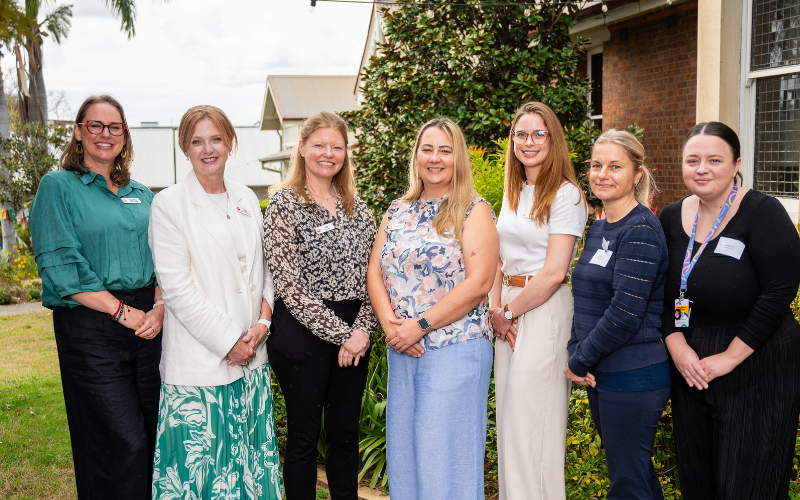
Photo courtesy of https://karuna.org.au/new-carer-services/
Today, Karuna’s values are reflected not just in posters or induction documents, but in the rhythm of the workday. They are embedded into systems and relationships, guiding both the big decisions and the small moments of connection.
In internal culture:
- Used as a framework in performance conversations and annual staff reviews
- Referenced in team discussions, especially during conflict resolution or project planning
- Integrated into supervision and peer support sessions
- Framed in how feedback is offered, not as critique, but as a collaborative act
In external service:
- Influencing how staff communicate with families, with a focus on compassion and honesty
- Guiding the tone of donor and supporter engagement, ensuring alignment with Karuna’s principles
- Helping the organisation decide which partnerships to pursue, choosing collaborators who share similar values
The values aren’t slogans. They are tools for connection, used every day to check intentions, navigate complexity and stay anchored in what matters most.
Kindness as a Strength, Not a Softness
Among the values chosen, kindness has emerged as a unifying thread. It’s not simply about being “nice”, it’s about a deeper orientation toward care, respect and courage.
As Ven Tsultrim shared during one of the workshops, kindness is often misunderstood as passive or overly gentle. But in reality, “kindness takes real strength, especially when directed at those who are suffering or acting out of pain.” She described kindness as a response that acknowledges our shared fragility, while still recognising accountability. “Kindness doesn’t mean there are no consequences. But it means we respond in a way that doesn’t create more harm.”
This view of kindness, as both ethical and practical, has influenced how Karuna staff speak to one another, support clients, and lead through challenge. In an age of polarisation, kindness is becoming Karuna’s quiet superpower.
Kindness in Action: Celebrating World Kindness Day
One of the most visible expressions of Karuna’s values came on 13 November, when the hospice hosted its first Online Kindness Festival to mark World Kindness Day.
The event featured Jennifer Nadel from Compassion in Politics, who spoke about the role of kindness in leadership and systems change, and Professor Robin Banerjee from the University of Sussex, who shared findings from The Kindness Test, the world’s largest study on kindness conducted with the BBC.
The morning closed with a “Talking Kindness Café”, where participants reflected together on the role of kindness in their lives and work. It was a simple but powerful reminder that kindness is more than a value, it’s a shared practice that can shape culture from the inside out.
A Culture That Connects and Sustains
Since embedding the new values, Karuna staff report a shift in tone and togetherness. There’s a deeper sense of shared purpose. People are more attuned to the roles their colleagues play, more willing to support one another, and more reflective in how they speak and act.
New staff, rather than feeling lost in jargon or vague ideals, are oriented immediately into a culture of care and clarity. The rotating workshop system ensures that no one misses out and that the values remain fresh, responsive and alive.
Far from becoming stale or overused, the values are now a thread running through every layer of Karuna’s work offering stability in times of change, and a mirror for ongoing growth.
Living What Matters
Karuna Hospice has shown what’s possible when values are not just declared but discovered, defined, and lived together. Their work with the 16 Guidelines is more than an organisational success, it’s a model of ethical culture-building that others in the hospice, health and care sectors can learn from.
By creating space for reflection, inclusion, and real-world application, Karuna has shaped a compassionate environment that is both courageous and cohesive.
In the end, it’s not just about the words on the page. It’s about how those words shape the way people treat each other at work, in care, and in the quiet moments of everyday life.
Let kindness lead.

Foundation for Developing Compassion and Wisdom (FDCW)
At FDCW, we are committed to a more compassionate, wiser world. We provide resources, courses and training to develop qualities such as kindness, patience and honesty – qualities that are essential for meeting the challenges of the world we all share.
The Foundation for Developing Compassion and Wisdom (FDCW) was established as a global charity based in London in 2005. Since then, we have provided secular training, programmes and resources across many sectors of society – schools, universities, hospices, workplaces, healthcare, youth groups and community centres. Our courses have reached thousands of people across the world through our dedicated and growing network of facilitators in more than 20 countries.
Support our Work
As a non-profit organization, FDCW relies on donations like yours to continue producing valuable resources and hosting events. You can support us by sharing our newsletter, following us on social media, and making a donation. Every contribution, big or small, helps us in our efforts and we truly appreciate it.


