Sharing the 16 Guidelines for life in France



Featuring: Hilary McMichael
In November and December 2025, Hilary McMichael led a 10-week Building on the Basics (BoB) online course in France with a group of ten participants who had completed the 16 Guidelines Level 2 course. One part of BoB invites participants to design a community project, something practical they can try in real settings, with the shared aim of bringing and sharing the 16 Guidelines for life into daily life and into spaces beyond the course group.
This autumn cohort chose a simple seasonal idea and made it flexible enough to fit different workplaces and communities. Their project became a secular “Advent” calendar, sometimes described as a “before the holidays” calendar. Not everyone built a full calendar, but everyone contributed. The group’s WhatsApp thread became the creative centre of the project, filling up with quotes, card-based games, short definitions, and personal stories. From this shared pool of ideas for sharing the 16 Guidelines for life, several participants created their own variations, shaped by what would feel natural in their context.
A key question soon emerged, and it was one many people recognise. How do you bring the spirit of the 16 Guidelines into public or professional settings without sounding “woo woo,” or as if you’re pushing a belief system? The group kept returning to the same answer: keep it simple, keep it invitational, and let people take part in their own way.
Workplace and school examples from the group
One participant, Chantal, felt that naming and sharing the 16 Guidelines for life would not be appropriate in her workplace. She found a more discreet approach. She tied a long string along a wall and pegged up a row of Yogi teabags, each one carrying its own small message. Gradually, coworkers began helping themselves to a tea and sharing the message they found. Some simply watched from the side, but Chantal noticed a shift in the atmosphere around the open-space tables. The space felt warmer, and she was thanked for what colleagues experienced as a gift to the team.
Another participant, Amandine, works in an educational institution and created a daily rhythm people could rely on. Each day, she pinned up a worksheet with a few lines on what the chosen Guideline meant, what it was not, and a quote. To keep things neutral, she did not name the author of the quote. Alongside this, she posted a second sheet with suggested activities, inviting adults or children into rooms where there might be a game, paper and crayons, or, on Generosity day, even a basket of cookies. Over time, she began to see the effect in small but clear ways. She received emails saying, “I miss the fact that you haven’t sent out today’s word,” and she noticed other emails beginning to include a quote, reflecting how a simple phrase can lift a day and travel further than expected.

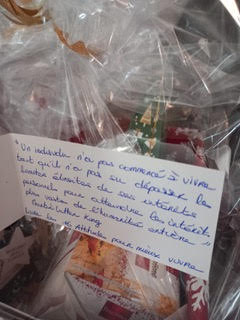
Roxane chose a more traditional calendar format, with small windows to open each day. Behind each window was a short piece of wisdom or a small challenge. She placed it in her workspace and paid attention to how people interacted with it. At first it was mainly her own practice, but over time something shifted. On days when she was not there, someone else opened the window. She also noticed more and more positive comments, with colleagues appreciating the benefits of something unexpected, and enjoying the quiet encouragement it brought into the workplace.
A fourth idea was discussed by the group, and one person carried it out. Yasmina made small gift packs containing a few treats to eat and a small item to keep, such as a notebook. Each pack included a Guideline definition and a quote from the book. Yasmina offered these to people in need, and also used them as a way to thank people who were helping others. It was a simple gesture, but it carried something important, care that is both practical and respectful.
Looking back, the group felt that BoB has a particular strength: it brings the 16 Guidelines into one’s life, and it asks people to cooperate rather than work in isolation. At the same time, they were honest about the challenge of making collective decisions in a limited time frame, especially online. There were many good ideas, and not always enough space to refine them into a small number of final shared outputs.
What lasted beyond the course
Even so, one outcome has lasted beyond the course itself. The WhatsApp group remains an ongoing resource, keeping participants connected and continuing to share ideas and encouragement. The group hopes to meet in person in the future, not to plan another project, but simply to celebrate what they built together.
What stands out in this community experiment is how grounded the approach remained. Instead of relying on long explanations, participants tested small daily prompts, light activities, and simple acts of generosity. In doing so, they found ways to share what matters, while giving others plenty of freedom to meet it in their own way.
An upcoming opportunity in the Tarn, in France
If this story sparked ideas, there’s an in-person workshop coming up at Vajra Yogini Institute in Marzens (Tarn): “Atelier, 16 Attitudes pour Mieux Vivre, Niveau 1 (en Français)”, running March 14 to March 15, 2026 (10:00 to 17:30 CET). The event is offered on a donation basis, and takes place over two days. You can also find out more about what’s on offer through Education Universelle France.
If you are looking for a structured and accessible way to explore the 16 Guidelines in your community, another way is through the 16 Guidelines Meditations Course which is available to download. Your donations help FDCW continue developing and sharing ethical education programmes around the world.

Foundation for Developing Compassion and Wisdom (FDCW)
At FDCW, we are committed to a more compassionate, wiser world. We provide resources, courses and training to develop qualities such as kindness, patience and honesty – qualities that are essential for meeting the challenges of the world we all share.
The Foundation for Developing Compassion and Wisdom (FDCW) was established as a global charity based in London in 2005. Since then, we have provided secular training, programmes and resources across many sectors of society – schools, universities, hospices, workplaces, healthcare, youth groups and community centres. Our courses have reached thousands of people across the world through our dedicated and growing network of facilitators in more than 20 countries.
Support our Work
As a non-profit organisation, FDCW relies on donations like yours to continue producing valuable resources and hosting events. You can support us by sharing our newsletter, following us on social media, and making a donation. Every contribution, big or small, helps us in our efforts and we truly appreciate it.