When Fear Wears the Mask of Courage


At the Foundation for Developing Compassion and Wisdom (FDCW), our ongoing series explores the shadow side of the 16 Guidelines. Each month, we reflect on how these core values, when misunderstood or shaped by unconscious habits, can appear in ways that limit our wellbeing and our connection with others. By bringing these patterns into awareness, we create space for deeper understanding, wiser choices, and meaningful change.
This month, we turn to the fourth theme of the 16 Guidelines: How we find meaning in life, with a focus on Courage – the willingness to act, speak and engage even when it is difficult. Courage is the sixteenth and final Guideline in this framework, and it feels a fitting one to close on. It asks something of us at every stage of the journey, including the courage to look honestly at ourselves.
Courage is widely admired. Yet even this most vital of qualities has a shadow. When ego, fear or the need to prove ourselves go unexamined, they can wear the mask of courage hiding something far less noble.
“Courage is not simply one of the virtues, but the form of every virtue at its testing point.”
— C.S. Lewis
The Paradox of Bravery
From childhood, courage is held up as something to aspire to. We celebrate those who speak up, step forward and face difficulty without flinching. To be courageous is to be strong. Yet experience tells a more complex story – not about courage itself, but about what can sometimes wear its name.
There are moments when what looks like courage is driven not by clarity, but by pride. When standing firm becomes an unwillingness to listen. When speaking up is less about truth and more about being heard. In such moments, something subtle has shifted. What began as genuine bravery may have slipped into something harder and less honest. This is not because courage is wrong. It is because our motivation is rarely simple. We may genuinely wish to act with integrity, and at the same time want to be seen as bold, unafraid or decisive. We may push forward without pausing to ask whether our action is wise, kind or truly necessary.
The problem is the shadow that can accompany Courage does not always appear as obvious recklessness. It can appear in subtler forms: the need to be seen as fearless, the avoidance of vulnerability dressed up as strength, the fear of rejection or the suppression of self-doubt in ourselves and others. Without awareness, what we call courage can reinforce disconnection rather than build it.
Recognising this paradox is not an invitation to become timid. It is an invitation to look more honestly. With greater self-awareness, we begin to notice when fear is quietly driving our boldness and from that recognition, something steadier and more genuine can emerge.
When Ego Wears the Mask of Courage

Courage, within the 16 Guidelines, is not about fearlessness. It is about acting wisely in the face of difficulty. Yet when the inner posture shifts, when what we call courage becomes about image, avoidance or control, it can undermine the very qualities it is meant to support.
Bravado and the Need to Appear Strong
One shadow of Courage appears as performance. We project confidence we do not fully feel, dismiss doubt as weakness and push forward regardless of the signals around us. On the surface, this looks like strength. Underneath, it can be a way of avoiding the discomfort of uncertainty.
True courage does not require us to pretend. It allows for doubt, for pausing, for admitting when we do not know. When we confuse bravado with bravery, we cut ourselves off from the very honesty that makes genuine courage possible.
Recklessness Mistaken for Boldness
Another shadow arises when action replaces reflection. We may act quickly in the name of courage, charging ahead without considering consequences, dismissing caution as timidity. Yet wisdom and courage are not opposites, they are partners.
Recklessness can risk causing real harm: to ourselves, to others and to the causes we care about. Courage that is grounded pauses long enough to ask whether the action is proportionate, timely and genuinely helpful. Sometimes the braver act is to wait, to listen or to change course.
Silencing Others in the Name of Truth
Courage is often associated with speaking up. Yet the shadow can appear when speaking becomes a way of dominating rather than contributing. We may use the language of honesty or directness to override others, justify unkindness or avoid the harder work of genuine dialogue.
Courageous speech, as understood within the 16 Guidelines, is paired with care. It considers not only what is true, but how truth can be shared in a way that opens rather than closes conversation.
Suppressing Vulnerability
Courage and vulnerability are deeply connected. Yet ego-driven boldness can lead us to treat vulnerability, our own or others’, as something to be overcome rather than understood. We push through pain, discourage others from expressing doubt and equate emotional openness with weakness.
In doing so, we may sever connection and belonging. Genuine courage includes the willingness to be seen honestly, to acknowledge difficulty and to remain present with what is uncertain or uncomfortable.
Fear Beneath the Surface
Sometimes what appears as courage is, on closer inspection, driven by fear. Fear of being overlooked. Fear of appearing weak. Fear of what might happen if we do not act. When fear is the engine, the action may look bold but feel brittle.
This is not a reason for self-criticism. It is an invitation to enquire. When we notice fear beneath our courage, we have the opportunity to act from a steadier, more honest place, one that is less reactive and more genuinely free.
The Other Shadow: When We Withdraw
The shadow of Courage does not only appear as excess. It can also appear as retreat. Faced with difficulty, conflict or the risk of being misunderstood, we may hold back, telling ourselves it is not our place, that it will not make a difference, or that the moment has passed.
This quiet withdrawal can become habitual. Gradually, we stop speaking, stop engaging and stop trusting our own capacity to act. What began as caution becomes a pattern of avoidance that distances us from meaning, from others and from ourselves.
“You gain strength, courage and confidence by every experience in which you really stop to look fear in the face.”
— Eleanor Roosevelt
Courage does not demand dramatic gestures. It is often expressed in small, consistent acts, saying the honest thing kindly, stepping out of our comfort zones by staying present when it is uncomfortable, trying again after failure. These moments shape character over time. When we recognise that courage need not be grand to be real, it becomes available again.
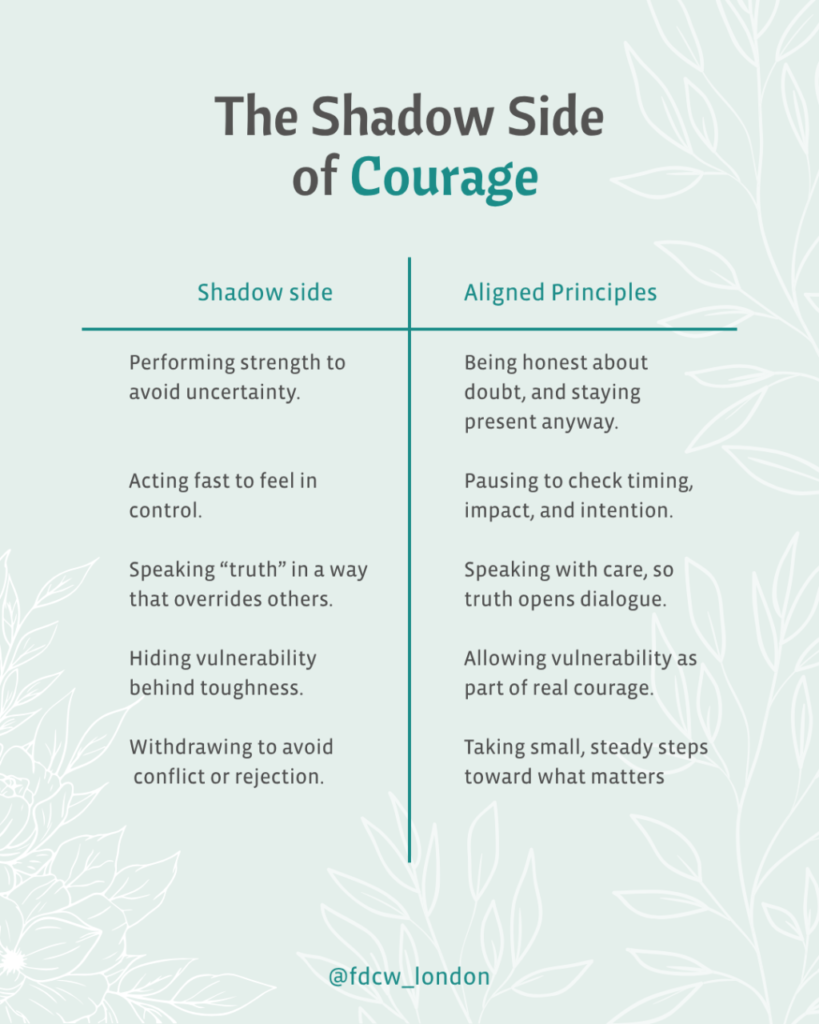
Sometimes it helps to see the contrast clearly. The graphic below maps each shadow pattern alongside its more aligned alternative.
Bringing Courage into Practice
Recognising when courage has drifted into shadow is not about self-criticism. It is about awareness. A simple pause can make a real difference. Before acting, we might ask: Is this coming from clarity or from fear? Am I acting with care as well as conviction?
Courage becomes clearer when we reflect regularly on what is driving us. Gentle enquiry, calming practices, mindfulness and honest self-observation help us notice when boldness has become performance, when speaking has become silencing, or when strength has become a way of avoiding vulnerability.
If you would like to explore this more deeply, you may find it helpful to listen to FDCW’s guided reflection on Courage available on Insight Timer, which is part of our online course. You can also explore this and the other Guidelines more fully through the Building Inner Strength: Core Values for a Happy Life online course, or by downloading the 16 Guidelines for a Happy Life App, which offers daily reflections and practical ways to embody the Guidelines in everyday life.
From Performing Courage to Living It

When our actions lose their way, it is rarely because we intended harm. More often, it is because we acted without full awareness, pushing forward too quickly, suppressing doubt, mistaking performance for strength, or withdrawing when presence was needed.
The work, then, is not to abandon courage, but to deepen it. When we examine our motivations honestly and gently, courage becomes clearer. It acts when action is needed and pauses when reflection is required. It speaks with honesty and with care. It remains present with difficulty without being driven by the need to appear unafraid.
Courage free from shadow does not seek to impress. It is not brittle or reactive. It is steady, grounded and genuinely responsive to what the moment requires. In this way, Courage fulfils its deeper purpose within the 16 Guidelines: not merely to act boldly, but to live with integrity, presence and an open heart.
Next month, we bring this series to a close with a final article reflecting on the journey as a whole, revisiting all 16 Guidelines, the patterns we have uncovered and what it means to live with greater awareness, compassion and wisdom. We hope you will join us for that conversation.

Foundation for Developing Compassion and Wisdom (FDCW)
At FDCW, we are committed to a more compassionate, wiser world. We provide resources, courses and training to develop qualities such as kindness, patience and honesty – qualities that are essential for meeting the challenges of the world we all share.
The Foundation for Developing Compassion and Wisdom (FDCW) was established as a global charity based in London in 2005. Since then, we have provided secular training, programmes and resources across many sectors of society – schools, universities, hospices, workplaces, healthcare, youth groups and community centres. Our courses have reached thousands of people across the world through our dedicated and growing network of facilitators in more than 20 countries.
Support our Work
As a non-profit organisation, FDCW relies on donations like yours to continue producing valuable resources and hosting events. You can support us by sharing our newsletter, following us on social media, and making a donation. Every contribution, big or small, helps us in our efforts, and we truly appreciate it.