

Being Creative with the 16 Guidelines

One of the strengths of the 16 Guidelines for Life is their flexibility. While there are courses, cards, meditations, activities and guides available through FDCW, many people find their own creative ways to adapt these resources for the communities they serve.
Recently, we heard two very different stories that demonstrate this beautifully. One came from a prison in France. The other began with a message from Jakarta. Although the settings could hardly be more different, both show how a simple idea can help people reflect on values, start meaningful conversations, and connect more deeply with themselves and others.
16 Guidelines Challenges
Janna Weiss a 16 Guidelines facilitator based in the USA, recently heard from a woman in Jakarta. During their conversation, Janna shared one of the resources she created based on the 16 guidelines that she uses alongside the 16 guidelines cards. The challenges invite people to take a value and put it into practice through a small, achievable action.
For example:
💡 Key Insight — Humility
When people try to speak with you, do you sometimes continue with what you are doing, such as cooking a meal, reading a newspaper or looking at a computer screen? Do you treat them as if they were not important enough to have your full attention? Next time this happens, stop what you are doing. Make eye contact and listen carefully. Note one new thing that you have learned.
Janna often invites people to pick a card and reflect on the challenge that accompanies it.
“It is a little bit like receiving a fortune cookie,” she explains. “People really like it.”
The activity is simple, but it creates a moment of pause and self-reflection. Sometimes people are so inspired that they ask for a copy of the challenges to continue using them at home.
Values-Based Games in a French Prison
In France, Olivier, a Buddhist chaplain working in prisons, took a different approach.
Together with Yasmina, who is following the 16 Guidelines Training Pathway, and with input from one of the prisoners he regularly visits, he adapted the 16 Guidelines into a series of games. The aim was to create something accessible, engaging and relevant to prison life.
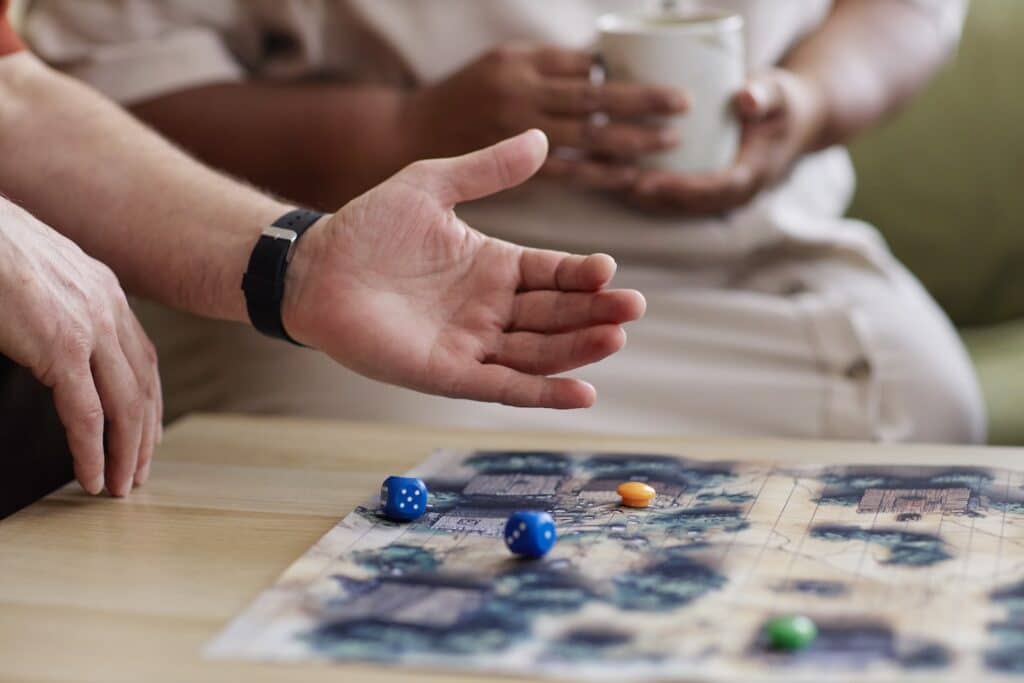
One game used dice and coloured categories linked to the four Wisdom Themes. Players rolled the dice, selected a guideline card, reflected on its meaning and then considered a practical challenge connected to that value.
Another activity, called the “Treasure Trail”, invited participants to think about a real situation in their lives and then explore whether a particular guideline might help them approach it differently.
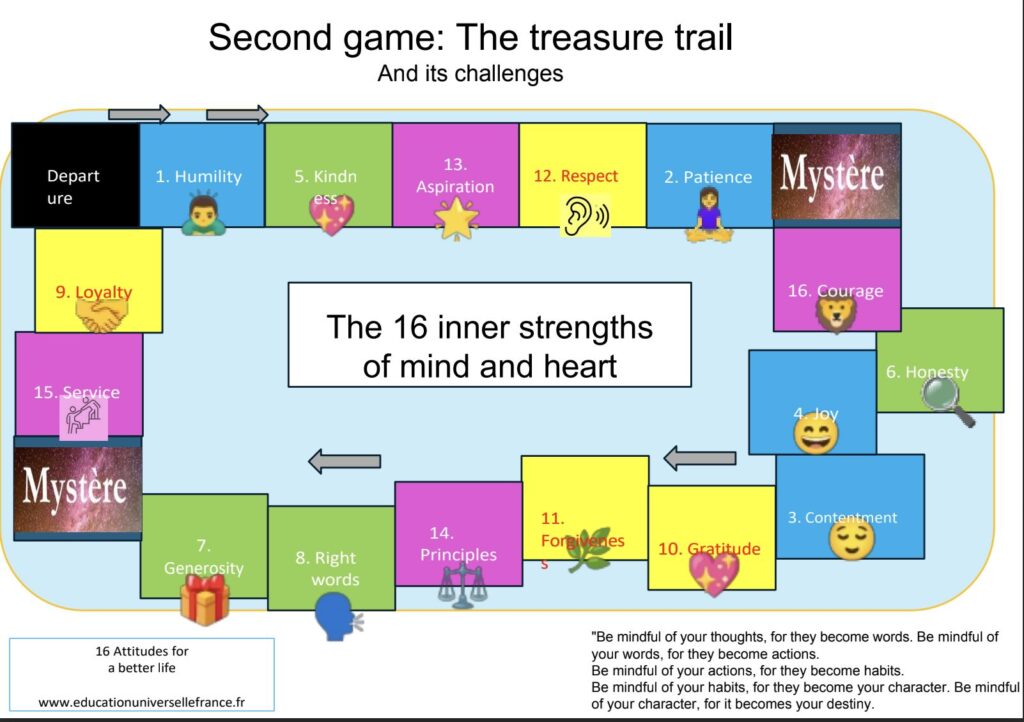
The challenges were adapted to suit the audience. For example:
💡 Key Insight — Patience: Accepting That Things Take Time
What Is It?
It is breathing instead of shouting. It is not losing your temper over nothing, even if things are not going the way you want them to. It’s understanding that others also need time. Accepting that things don’t always happen the way we want them to, or when we want them to.
Why Is It Important?
You do fewer stupid things when you’re angry. It avoids arguments. It makes life calmer. It shows respect for others. It calms things down and builds trust.
Caution
Being patient does not mean accepting everything. You also need to speak up if something is wrong. Changing yourself takes time — you have to accept that.
Remember
There’s no point in getting upset about everything; things take time. With patience, you can keep a cool head. You can think before you act.
And you, do you use this attitude?
What action have you taken that shows this attitude?
Have you seen anyone else act this way?
Patience Challenge
The next time someone annoys you:
• Try not to react immediately. Wait a few seconds or minutes.
• Before reacting, think: “Maybe he’s struggling too.”
• Will getting angry solve anything?
• Breathe. Give yourself time to feel calm inside. Think.
The games brought together prisoners, prison officers and staff members in a shared activity. Participants often recognised themselves in the values they encountered and found themselves talking openly about experiences, strengths and challenges.
What began as a simple game became an opportunity for genuine human connection.
The Principle Behind Both Stories
Neither Janna nor Olivier created a completely new programme. Instead, they started with existing 16 Guidelines resources and adapted them to fit the people in front of them.
One used reflection cards and practical challenges in conversations with individuals. The other transformed the same values into interactive games for groups. The principle is the same: take a value, make it accessible, and create an opportunity for people to reflect on their own lives.
Ideas You Could Try
You do not need to be a facilitator, teacher or chaplain to adapt the 16 Guidelines.
People have successfully used the resources in:
- Community groups
- Schools
- Youth activities
- Family discussions
- One-to-one mentoring
- Workplace wellbeing sessions
- Informal conversations with friends
You might invite people to draw a card and discuss it, create a weekly challenge based on one guideline, or you might adapt the values into a game, journal exercise or discussion group. The format matters less than the intention behind it.
Start with the Resources You Already Have
If these stories inspire you, a good place to begin is with the free 16 Guidelines Cards and other resources available through FDCW. You do not need to reinvent the wheel. Sometimes the most effective ideas come from taking an existing resource and adapting it for the people and circumstances around you.
As these stories from Jakarta and France remind us, the 16 Guidelines do not belong in a particular setting. They can be used wherever people are willing to pause, reflect, and have a conversation about what really matters.

Foundation for Developing Compassion and Wisdom (FDCW)
We provide resources, courses and training to develop qualities such as kindness, patience and honesty – qualities that are essential for meeting the challenges of the world we all share.
The Foundation for Developing Compassion and Wisdom (FDCW) was established as a global charity based in London in 2005. Since then, we have provided secular training, programmes and resources across many sectors of society – schools, universities, hospices, workplaces, healthcare, youth groups and community centres. Our courses have reached thousands of people across the world through our dedicated and growing network of facilitators in more than 20 countries.


